Walk onto any construction site or manufacturing floor, and you will see a world built on geometry. The strength of a skyscraper, the chassis of a truck, and the framework of a conveyor belt all rely on specific engineering choices. While the material itself—whether steel, aluminum, or brass—is crucial, the geometry of the material is equally important. This is where metal shapes come into play.
Industrial components are rarely just solid blocks of material. Instead, they are processed into specific profiles designed to maximize strength, minimize weight, and allow for efficient assembly. From the massive beams that support bridges to the intricate channels used in window frames, shapes of metal are the fundamental building blocks of modern infrastructure.
Choosing the correct profile is not just a matter of aesthetics; it is a calculation of physics and economics. The right shape can reduce material costs while increasing load-bearing capacity. This guide explores the most essential profiles used today, examining how they are made, where they are used, and why specific geometries are chosen for specific tasks.
What Are Metal Shapes?
A metal shape refers to a piece of metal that has been formed into a specific cross-sectional profile. These profiles are consistent throughout the length of the bar, tube, or beam. In the industrial world, these are often referred to as “structural shapes” or “sections.”
The process begins with raw metal, which is transformed into a usable configuration. This transformation allows engineers to predict how the component will behave under stress. For instance, a flat sheet of steel behaves very differently than that same steel bent into a 90-degree angle. The metal shape profile dictates the component’s resistance to bending, twisting, and compression.
Most industries rely on standard shapes—profiles that have been standardized by organizations like ASTM International to ensure consistency in size, tolerance, and structural properties. However, there is also a vast market for custom profiles tailored to unique machinery or architectural needs.
Common materials used to create these profiles include:
- Steel: The go-to for heavy construction due to its immense strength.
- Aluminum: Prized for being lightweight and corrosion-resistant, ideal for aerospace and window frames.
- Stainless Steel: Used where hygiene or high corrosion resistance is needed, such as in food processing or chemical plants.
- Brass and Copper: Often selected for electrical conductivity or decorative purposes.
How Metal Shapes Are Manufactured
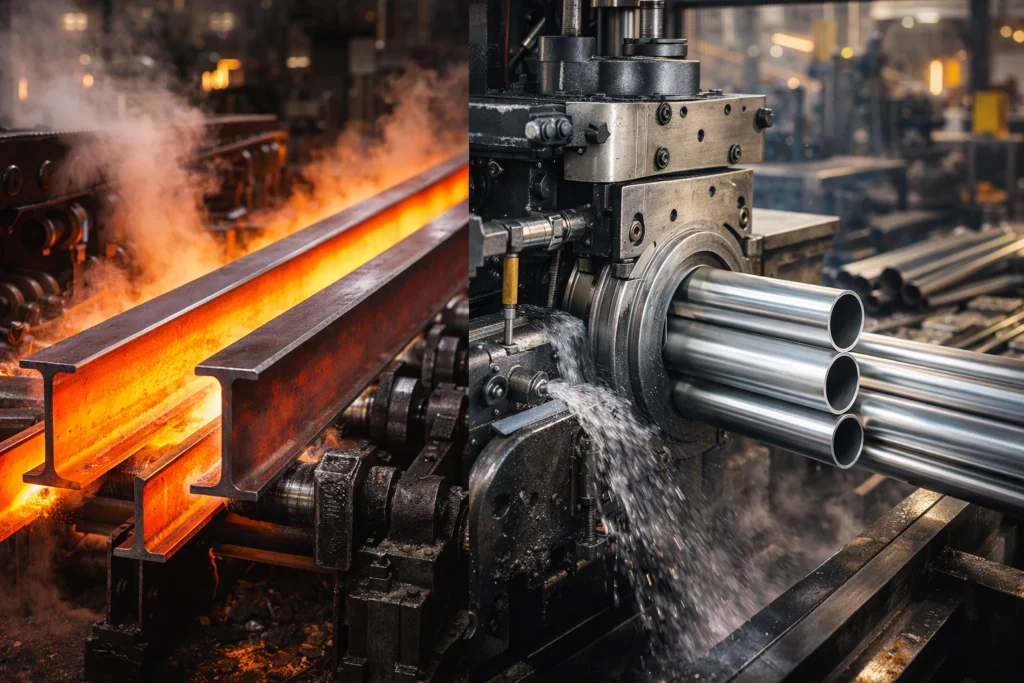
To create specific shapes of metal, manufacturers utilize several distinct processes. The chosen method depends on the type of metal, the complexity of the profile, and the required volume.
Rolling
Rolling is the most common method for producing heavy structural steel. In this process, metal stock is passed through a series of heavy rollers while it is either hot (hot rolling) or at room temperature (cold rolling). As the metal passes through the rollers, it is gradually squeezed into the desired profile, such as an I-beam or an angle. Hot rolling is generally used for large structural components, while cold rolling produces tighter tolerances and a smoother finish.
Extrusion
Extrusion is like squeezing toothpaste out of a tube. A heated billet of metal (usually aluminum or copper) is forced through a die with a specific cross-sectional opening. This creates a long, continuous piece with a consistent profile. Extrusion is excellent for creating complex profiles with hollow sections or intricate grooves that would be impossible to roll.
Casting
For extremely complex shapes of metal that cannot be rolled or extruded, casting is the solution. Molten metal is poured into a mold and allowed to solidify. This is often used for joint components, valves, or decorative heavy ironwork.
Fabrication
Sometimes, a standard rolled or extruded shape isn’t enough. Fabrication involves cutting, bending, and welding flat sheets or standard plates to build a custom shape. This provides infinite flexibility for specific industrial requirements.
Common Types of Metal Shapes Used in Industrial Applications
The variety of profiles available is extensive, but a few core shapes dominate the market due to their versatility and structural efficiency.
Angle Metal Shapes
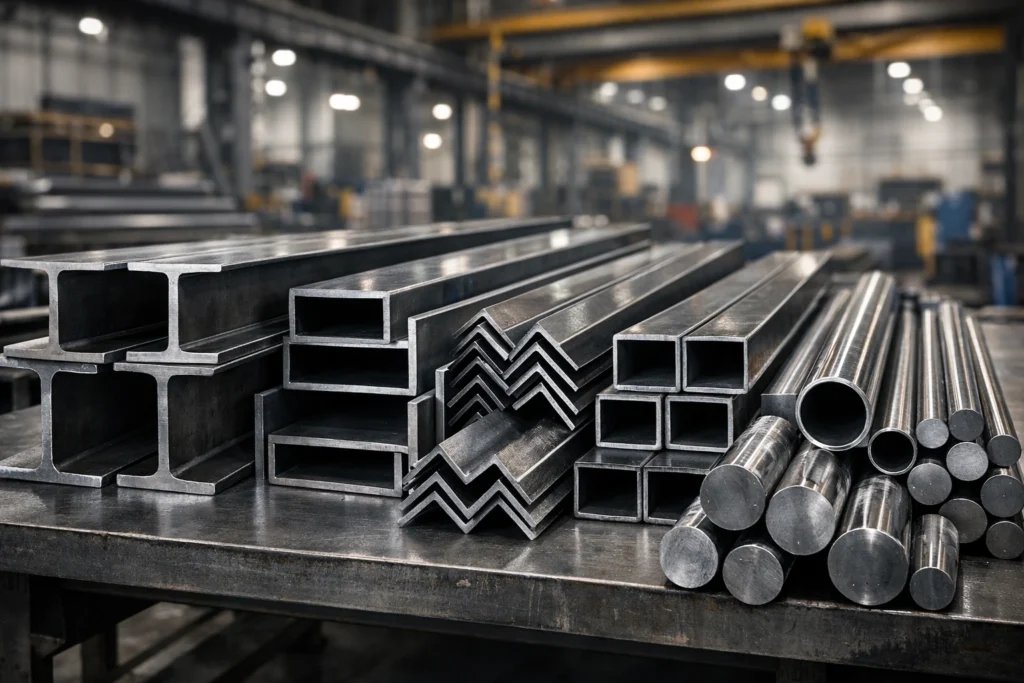
Angle iron, or angle bar, is one of the most recognizable metal shapes. It features an L-shaped cross-section with two legs that form a 90-degree angle. These legs can be of equal length or unequal length, depending on the application.
- Uses: Angles are used universally for brackets, framing, reinforcements, and shelving. In construction, they often serve as lintels above doors or windows.
- Benefits: The 90-degree bend provides significant resistance to bending in two directions. They are also easy to bolt, weld, and cut, making them a favorite for on-site repairs and fabrication.
Channel Metal Shapes
Channel profiles look like a “U” or a “C”. They consist of a wide “web” (the vertical back) and two “flanges” (the horizontal top and bottom extensions).
- Uses: These are frequently used as structural supports where weight savings are necessary. You will see them in vehicle chassis frames, supports for commercial buildings, and machinery frames.
- Benefits: Channels offer good rigidity when force is applied to the web side. They provide a flat surface for mounting other components while offering better structural strength than a flat bar of the same weight.
Beam Metal Shapes (I-Beams and H-Beams)
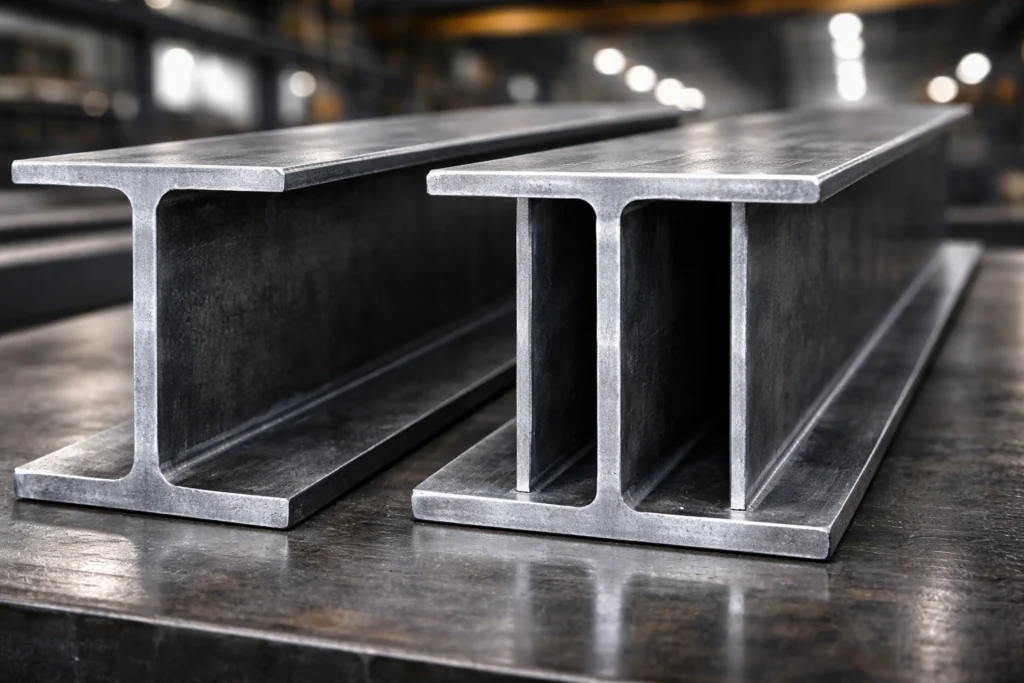
When you think of heavy construction, you think of beams. These metal shapes look like the letter “I” or “H”. They have a vertical web that connects two horizontal flanges.
- Structural Role: The shape is engineered to handle massive bending loads. The web resists shear forces, while the flanges resist bending moments.
- Applications: These are the primary support structures for skyscrapers, bridges, and industrial warehouses. H-beams (which have wider flanges) are often driven into the ground as pile foundations.
Tube Shapes and Pipe Profiles
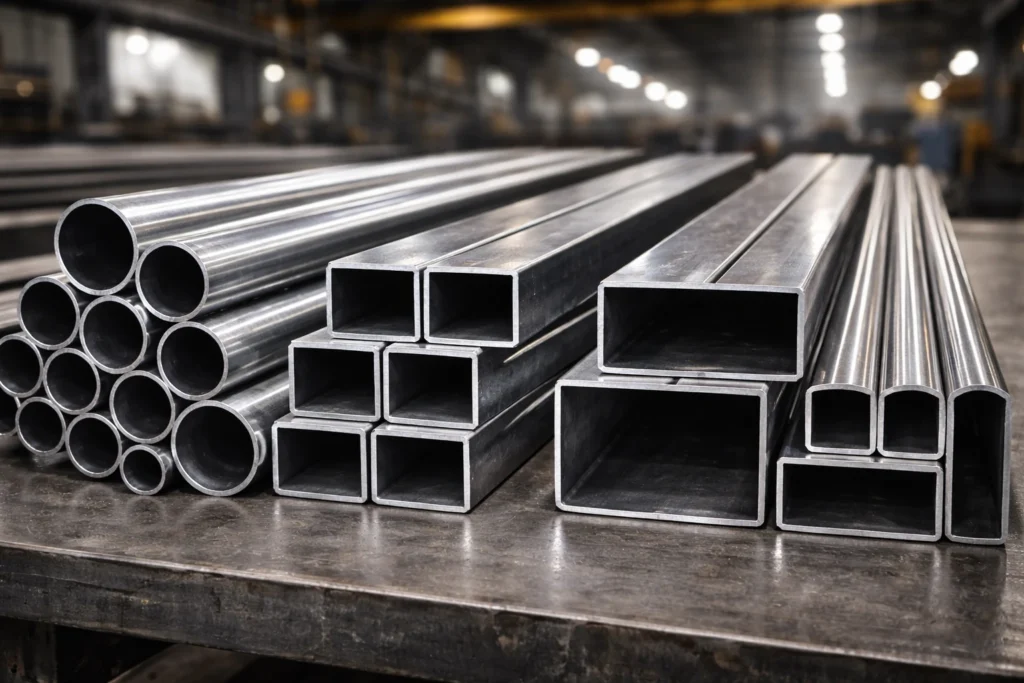
While often used interchangeably in casual conversation, tubes and pipes are different. Pipes are measured by their ability to transport volume (internal diameter), whereas tube shapes are measured by their outside dimensions and are primarily structural.
Tube shapes generally fall into three categories:
- Round Tube Shapes: These provide uniform strength in all directions. They are aerodynamic and aesthetically pleasing.
- Square Tube Shapes: Easier to weld and join than round tubes because of their flat surfaces. They are used heavily in building columns and machine frames.
- Rectangular Tube Shapes: Similar to square tubes but with different aspect ratios, allowing for greater strength in one direction, similar to a beam.
Industrial Applications of Tube Shapes:
- Structural Frameworks: From roll cages in race cars to the skeletons of commercial buildings, tube shapes are essential.
- Fluid and Gas Transport: While pipes are the standard, specialized tubing is used for hydraulic lines and high-pressure systems.
- Machinery: Conveyor rollers, shafts, and robotic arms often utilize tubular profiles.
Benefits:
The primary advantage of tube metal shapes is their strength-to-weight ratio. A hollow tube is significantly lighter than a solid bar of the same size but retains much of the rigidity, particularly regarding torsion (twisting). This makes them ideal for automotive and aerospace applications where weight reduction is critical.
Flat Bar Metal Shapes
Flat bars are exactly what they sound like: long, rectangular sections of metal. They come in varying thicknesses and widths.
- Uses: Flat bars are the “duct tape” of the metal world. They are used for base plates, manufacturing brackets, bracing, and ornamental work.
- Advantages: They are incredibly easy to manipulate. Flat bars can be bent, twisted, punched, and welded with minimal effort.
Round Bar Metal Shapes
Solid cylindrical bars are distinct from hollow tubes.
- Applications: Because they are solid, they are incredibly strong. They are machined into axles, shafts, fasteners, and bolts. In construction, thick round bars serve as anchor bolts for foundations.
Specialized Shapes of Metal for Industrial Use
Beyond the standard profiles, certain industries require specialized geometries to solve specific engineering problems.
T-Shaped Metal Profiles
A T-bar or T-beam looks like the letter “T”. It is essentially an I-beam cut in half down the center of the web.
- Benefits: It offers a flat surface for attachment with a vertical rib for strength.
- Applications: These are commonly found in ship construction and as reinforcements for plate metal. They are also the standard shape for the rails that hold up drop ceilings.
Z-Shaped Metal Profiles
Z-bars have a web with two flanges pointing in opposite directions.
- Design Advantages: This shape allows for overlapping.
- Usage: They are widely used in the metal roofing industry as “purlins.” They support the roof deck and can be nested together for efficient transport.
Custom Metal Shapes
Sometimes, a standard catalog doesn’t have the answer. In these cases, engineers commission custom shapes of metal.
- Precision Fit: A custom aluminum extrusion, for example, can be designed with built-in screw ports, heat sink fins, and interlocking snap-fits.
- Reduced Waste: By creating a shape that is near-net-shape (close to the final geometry), manufacturers reduce machining time and material scrap.
- Industries: Window and door manufacturers, automotive trim suppliers, and electronics housing manufacturers rely heavily on custom profiles.
Industrial Applications of Metal Shapes
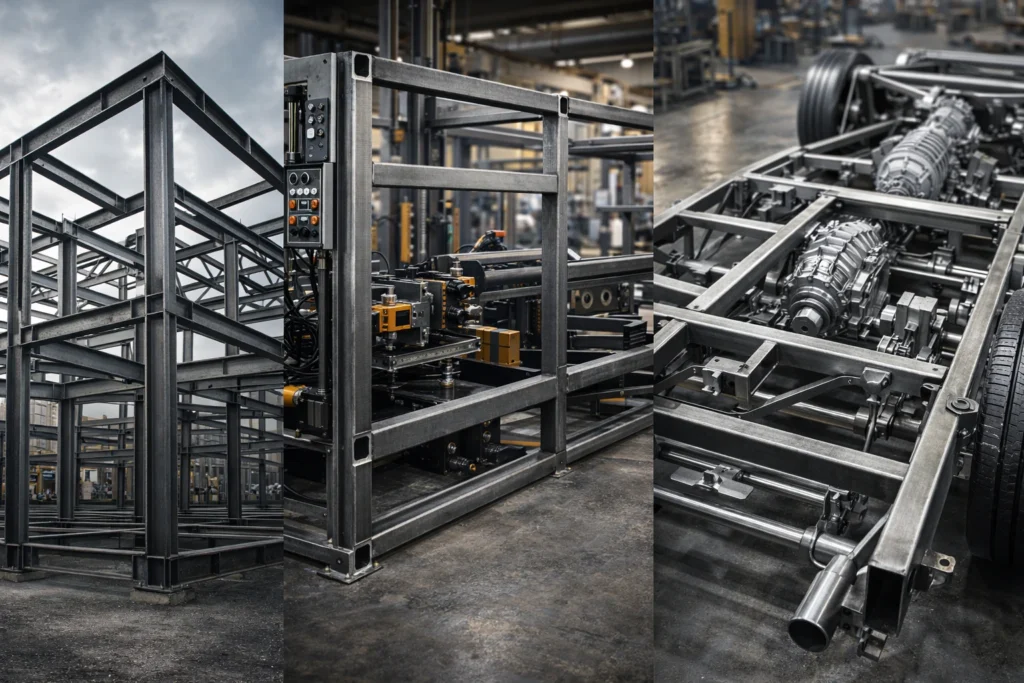
The utility of these profiles spans every sector of the economy.
- Construction and Infrastructure: This is the largest consumer of metal shapes. Steel beams form the skeleton of buildings; angles and channels support the walls and mechanical systems; Rebar (a round bar shape) reinforces concrete.
- Manufacturing and Fabrication: Machine bases are often welded together using square tube shapes and heavy plates. Assembly lines rely on aluminum extrusion profiles (often called T-slot) to build modular workstations.
- Automotive and Transportation: Vehicle frames use high-strength steel channels. Truck trailers rely on aluminum Z-bars and custom extrusions to keep weight down while maximizing cargo capacity.
- Energy and Power Generation: Transmission towers are giant lattices made of galvanized steel angles. Solar panel racking systems utilize specialized aluminum rails.
- Aerospace: This industry demands high-strength aluminum and titanium alloys extruded into custom shapes to form the ribs and stringers of aircraft fuselages.
Factors to Consider When Choosing Metal Shapes
Selecting the right profile is a balancing act. Engineers must consider several variables.
- Load-Bearing Requirements: How much weight must it hold? Is the force compression, tension, or torque? A beam is great for bending loads, while a round tube is better for twisting loads.
- Environmental Conditions: Will it be exposed to rain, salt, or chemicals? This dictates the material choice or the need for a protective coating (like galvanization).
- Material Selection: Steel offers the best strength-per-dollar. Aluminum offers the best strength-per-weight. Stainless steel offers longevity.
- Cost Efficiency: Standard shapes are cheaper and readily available. Custom shapes have high upfront tooling costs but save money in assembly for high-volume production.
- Precision and Tolerances: Some shapes, like cold-rolled bars, come with very tight dimensional tolerances suitable for machining. Hot-rolled structural shapes have looser tolerances suitable for construction.
Benefits of Using the Right Metal Shape
Using the correct metal shape optimizes the entire project.
- Improved Performance: The structure will be more rigid and less prone to failure.
- Cost Savings: Using a hollow tube instead of a solid bar reduces material weight and shipping costs.
- Durability and Safety: Proper profile selection ensures the structure can handle environmental stressors like wind loads or seismic activity.
- Efficient Fabrication: Standard shapes are compatible with standard hardware, making assembly faster.
Standard vs Custom Metal Shapes
For most projects, standard metal shapes are the logical choice. They are stocked by local service centers, have known structural properties, and are cost-effective. If you are building a warehouse or a trailer, standard beams and channels are the answer.
However, custom shapes are superior when a component needs to perform multiple functions. If a single piece of aluminum extrusion can act as a structural frame, a heat sink, and a housing for a circuit board, the custom tooling cost is easily justified by the elimination of assembly steps and fasteners.
Conclusion
From the humble angle iron to the massive I-beam, metal shapes are the silent partners in industrial progress. They transform raw elements into functional structures that house our businesses, transport our goods, and power our lives.
Understanding the difference between a channel and a beam, or recognizing the efficiency of tube shapes, allows for smarter engineering and better construction. Whether you are designing a new product or erecting a building, selecting the right metal shape profile is the first step toward a successful project.
If you are unsure which profile fits your specific load requirements or environmental needs, it is always best to consult with a structural engineer or a metal supplier.
FAQs About Metal Shapes
What are the most commonly used metal shapes in industry?
The most ubiquitous shapes are angles, channels, beams (I and H), and various tube shapes. These cover the vast majority of structural and framing needs across construction and manufacturing.
Which shapes of metal are best for structural applications?
For heavy structural loads, I-beams and H-beams are superior due to their ability to resist bending. For columns and frames where twisting forces might be present, square or rectangular tube metal shapes are often the best choice.
Can metal shapes be customized?
Yes. While standard profiles are widely available, manufacturers can create custom shapes of metal through extrusion (for aluminum and plastics) or fabrication (cutting and welding standard plates) to meet unique design requirements.