Choosing the right metal for your project can feel overwhelming. Whether you are buying a new watch, upgrading a 4×4 vehicle, selecting materials for industrial machinery, or even choosing cookware, the decision often comes down to two popular options: titanium and stainless steel.
Both metals are known for strength, durability, and long service life. However, they perform very differently depending on weight requirements, environmental exposure, cost, and appearance. Understanding the real differences between titanium and stainless steel can help you avoid costly mistakes and select the metal that truly fits your needs.
This in depth guide breaks down everything you need to know about titanium vs stainless steel in simple terms. We will cover composition, strength, weight, corrosion resistance, cost, real world applications, and how to identify each metal. By the end, you will know exactly which material makes the most sense for your project.
Understanding the Metals
Before diving into a direct comparison, it’s helpful to understand exactly what we are working with. Both metals are alloys, meaning they are mixtures of elements designed to enhance specific properties like strength or rust resistance.
What is Titanium?
Titanium is a transition metal known for being as strong as steel but significantly lighter. It has a high tensile strength and is naturally resistant to corrosion, thanks to a thin oxide film that forms on its surface when exposed to air.
There are various grades of titanium, generally categorized into commercially pure grades (Grades 1–4) and alloys (like Grade 5, often used in aerospace).
- Grade 1–4: Excellent corrosion resistance, easier to form.
- Grade 5 (Ti-6Al-4V): The most common alloy, offering extremely high strength and heat resistance.
Common applications include aerospace components, medical implants (because it’s biocompatible), high-performance automotive parts, and premium jewelry. Its lifespan is exceptional; titanium structures can last decades without significant degradation, even in harsh saltwater environments.
What is Stainless Steel?
Stainless steel is an alloy of iron, carbon, and chromium. The chromium is the secret ingredient that prevents rust. It is durable, widely available, and generally heavier than titanium.
Like titanium, stainless steel comes in different families and grades:
- 304 Stainless Steel: The standard “18/8” stainless used in kitchenware and appliances.
- 316 Stainless Steel: Contains molybdenum for better resistance to salt and chlorides (marine grade).
- 430 Stainless Steel: Magnetic and less corrosion-resistant, often used for decorative trim.
You’ll find stainless steel everywhere—from the cutlery in your drawer to the structural beams of skyscrapers and the exhaust systems of cars.
Titanium Steel vs Stainless Steel
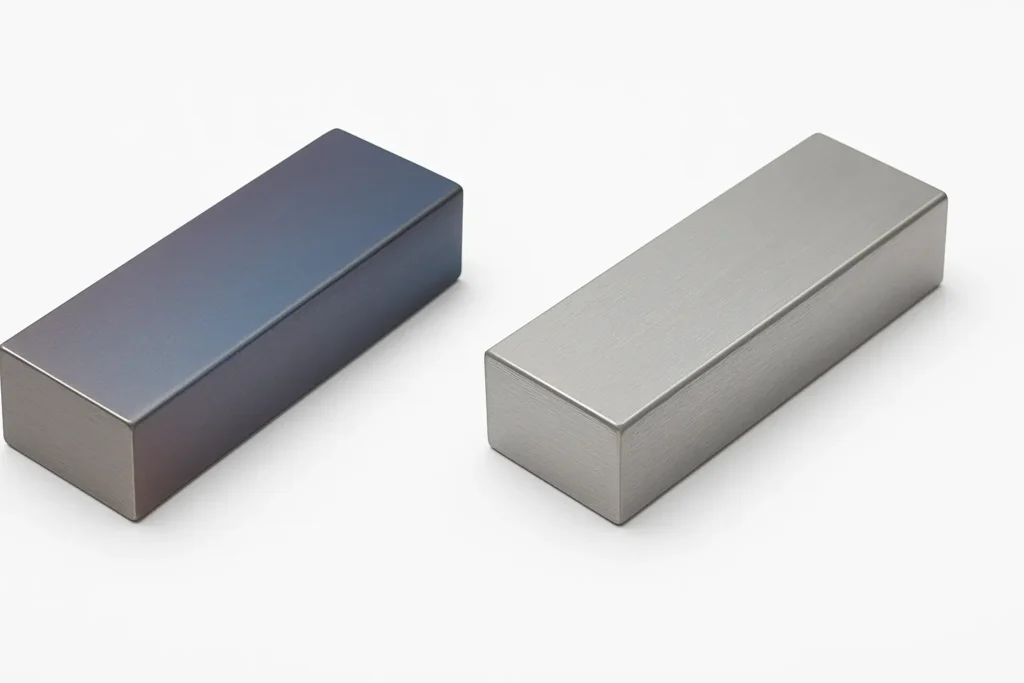
You might see the term “titanium steel” used in marketing, particularly for jewelry. It’s often a misnomer or a marketing term for stainless steel that has been coated or treated to look like titanium or has a very small amount of titanium added. However, regarding the raw material properties, here is a quick look at what is titanium steel vs stainless steel (treating titanium steel as pure titanium for this comparison):
Property | Titanium | Stainless Steel |
|---|---|---|
Base Element | Titanium (Ti) | Iron (Fe) |
Density | Low (~4.5 g/cm³) | High (~8.0 g/cm³) |
Strength-to-Weight | High | Moderate |
Cost | High | Low to Moderate |
Key Differences Between Titanium and Stainless Steel
Strength and Durability
Both titanium and stainless steel are strong materials, but they excel in different ways.
Stainless steel can achieve very high absolute strength, especially in certain alloys. It is highly resistant to impact and deformation and performs well under heavy loads. This makes it ideal for structural and industrial applications.
Titanium’s advantage lies in its strength to weight ratio. Titanium is nearly as strong as steel while being about forty to forty five percent lighter. For applications where reducing weight is critical, titanium offers superior performance.
Titanium also has excellent fatigue resistance, meaning it handles repeated stress cycles better over time. This is one reason it is used in aircraft and racing components.
Weight and Density
Weight is often the deciding factor between titanium and stainless steel.
Titanium has a density of approximately 4.5 grams per cubic centimeter.
Stainless steel has a density of about 8 grams per cubic centimeter.
This difference means titanium components feel dramatically lighter than stainless steel parts of the same size. In watches, vehicles, or wearable items, this weight reduction significantly improves comfort and performance.
Corrosion Resistance
Titanium is one of the most corrosion resistant metals available. It is virtually immune to rust and corrosion in normal atmospheric conditions, seawater, and many chemical environments. Even when scratched, the protective oxide layer reforms instantly.
Stainless steel is highly resistant to rust but not completely immune. In environments with high salt exposure, chlorine, or chemicals, stainless steel can develop pitting or surface corrosion over time. Marine grade stainless steel performs better but still cannot match titanium’s corrosion resistance.
Cost Comparison
Cost is one of the biggest differences between titanium and stainless steel.
Titanium is expensive to extract, refine, and machine. The production process requires significant energy, and the metal is difficult on cutting tools. These factors increase manufacturing costs.
Stainless steel is far more affordable. It is easy to produce in large quantities and is simpler to machine and weld. For most everyday applications, stainless steel provides excellent value for the price.
Appearance and Finish
Titanium typically has a darker gray or matte finish. It has a modern, industrial look that appeals to users who prefer subtle aesthetics. Titanium can also be anodized to produce vibrant colors without paint or coatings.
Stainless steel is brighter and more reflective. It can be polished to a mirror finish, which is why it is popular in luxury watches, jewelry, kitchen appliances, and decorative architecture.
Heat Resistance and Thermal Properties
Titanium performs extremely well at high temperatures and retains its strength under heat. It also has low thermal conductivity, meaning it does not transfer heat quickly. This makes it comfortable for wearable items and suitable for aerospace and exhaust components.
Stainless steel conducts heat more readily than titanium. While it handles moderate heat well, prolonged exposure to extreme temperatures can reduce its strength or cause warping.
Magnetic Properties
Titanium is completely non magnetic. This makes it ideal for medical implants, MRI environments, and sensitive electronic equipment.
Stainless steel may or may not be magnetic depending on the grade. Austenitic grades like 304 and 316 are mostly non magnetic, while ferritic and martensitic grades are magnetic.
How to Tell Titanium vs Stainless Steel
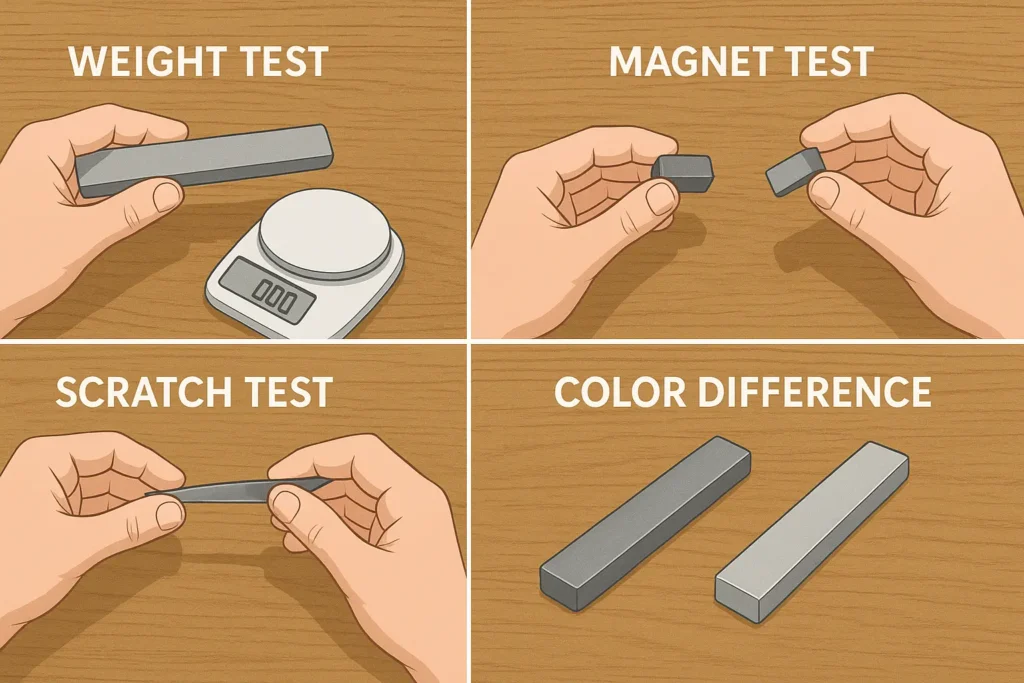
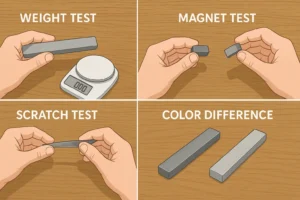
If you have two pieces of metal and aren’t sure which is which, here is how to tell titanium vs stainless steel using a few simple tests.
Visual Inspection
Look at the color. Stainless steel usually has a brighter, whiter, silver shine. Titanium tends to be a darker, muted gray, somewhat similar to gunmetal. If the metal is anodized in a bright rainbow color, it’s likely titanium.
Weight Test
Hold the items in your hand. If they are roughly the same size, the titanium piece will feel surprisingly light, almost like aluminum but harder. The stainless steel piece will feel dense and substantial.
Magnet Test
Use a strong magnet. If the magnet sticks firmly, it is almost certainly a grade of stainless steel (or regular steel). If it doesn’t stick at all, it could be titanium or high-grade stainless (304/316). While not definitive on its own, it helps rule out magnetic steel grades.
Scratch and Hardness Test
Titanium is generally harder and more scratch-resistant than stainless steel, although it can still scratch. If you run a file across an inconspicuous area:
- Titanium: Will produce white sparks (if using a grinder) and is very resistant to filing.
- Stainless Steel: Will produce orange/yellow sparks and files down more easily.
Chemical or Acid Test
This is more extreme, but titanium is unaffected by most acids. Stainless steel can discolor or corrode if exposed to strong hydrochloric or sulfuric acid. (Always exercise caution with chemicals).
Applications: When to Use Titanium vs Stainless Steel
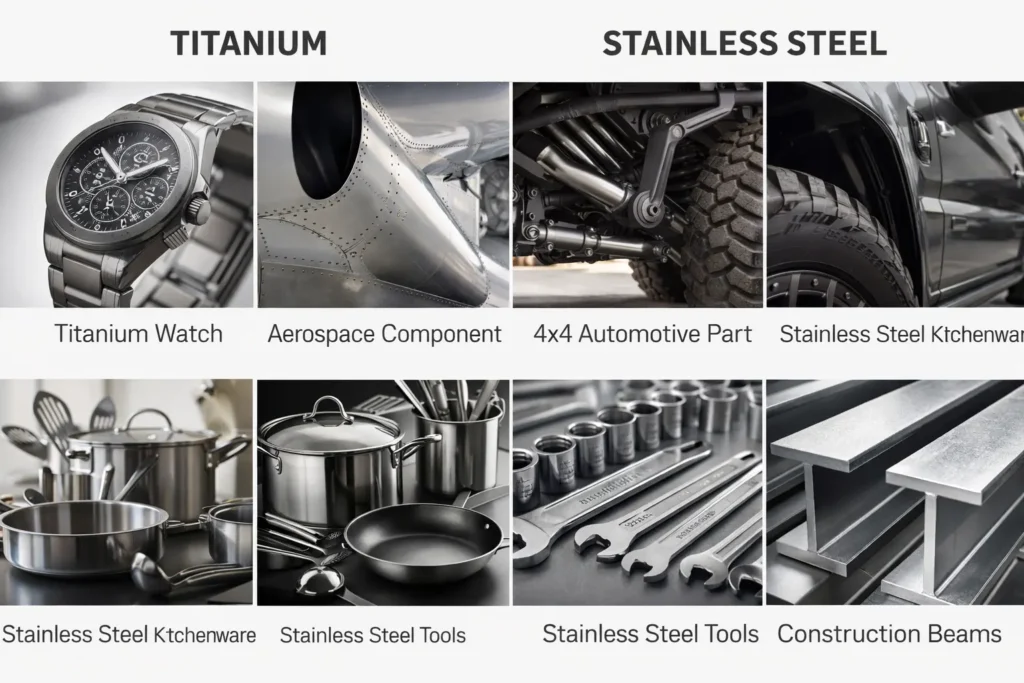
Choosing between these metals depends entirely on what you need the object to do.
Jewelry and Watches
Titanium is hypoallergenic, meaning it won’t cause skin irritation for those with nickel allergies (a common issue with some stainless steel). It is lightweight and comfortable for all-day wear. Stainless steel is preferred for “dressy” watches due to its high polish and weighty, premium feel.
Medical Implants and Surgical Tools
Titanium is the gold standard for implants (hips, knees, dental posts) because it is biocompatible—the bone can actually grow into the metal (osseointegration). Stainless steel is still widely used for surgical tools (scalpels, clamps) because it is durable, easy to sterilize, and sharpens well.
Industrial and Automotive Parts
For high-performance automotive and 4×4 parts, titanium is used for exhausts, valves, and suspension springs to reduce weight. However, due to cost, stainless steel is the standard for exhaust systems and structural components in 99% of vehicles.
Consumer Products
- Titanium: Camping gear (super light mugs/pots), high-end spectacle frames, premium EDC (everyday carry) pens.
- Stainless Steel: Kitchen sinks, cutlery, washing machine drums, screwdrivers, wrenches.
Pros and Cons of Titanium and Stainless Steel
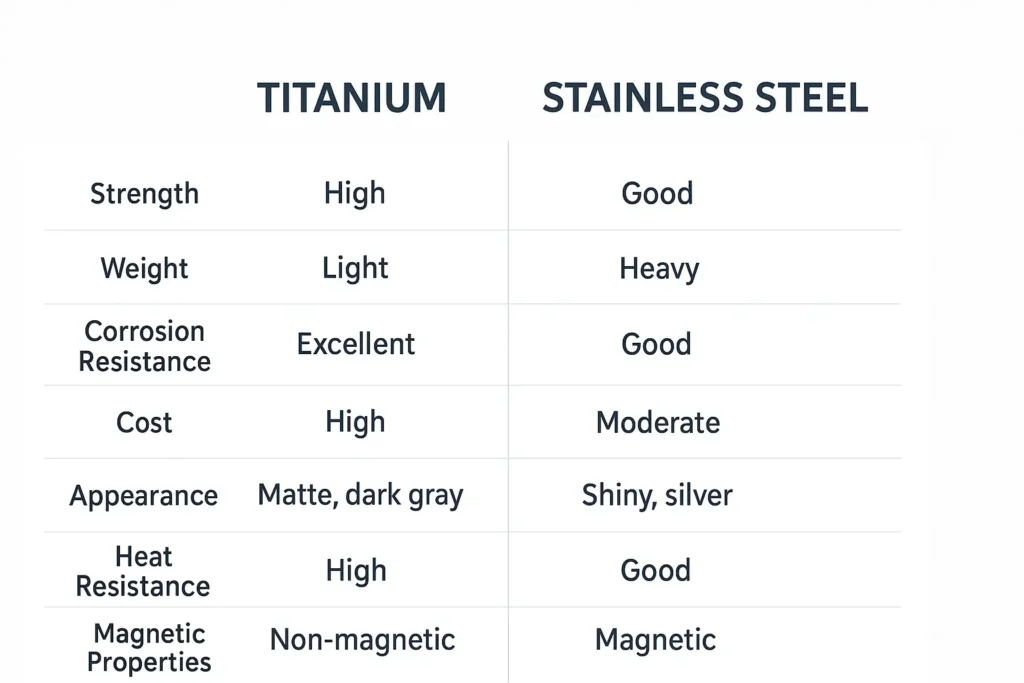
Here is a quick reference table to help summarize the trade-offs.
Feature | Titanium | Stainless Steel |
|---|---|---|
Strength | High (High Strength-to-Weight) | Medium to High |
Weight | Light | Heavy |
Corrosion | Excellent (Saltwater proof) | Good (Can pit in harsh conditions) |
Cost | High | Affordable |
Appearance | Matte, darker gray | Shiny, silvery, reflective |
Heat Resistance | Excellent | Moderate |
Magnetic | Non-magnetic | Sometimes magnetic |
Titanium vs Stainless Steel: Cost vs Value
When analyzing does stainless steel vs titanium offer better value, you have to look at longevity vs. upfront cost.
Titanium requires a higher initial investment. If you are buying a titanium exhaust for your car, you might pay $2,000 instead of $800 for stainless steel. The value comes if you are racing and need to save weight, or if you live on the coast and want an exhaust that will never rust out.
For everyday items, stainless steel offers incredible value. A stainless steel cooking pot will last a lifetime for a fraction of the price of titanium cookware. Unless the specific properties of titanium (weight savings, bio-compatibility) are required, stainless steel is usually the smarter financial choice.
Titanium vs Stainless Steel in Everyday Life
You likely encounter the stainless steel vs titanium battle daily without realizing it.
- Jewelry: If you wear a wedding band that feels nonexistent on your finger, it’s likely titanium. If you like the feeling of “heft” in a luxury watch, you probably prefer stainless steel.
- Kitchen: Professional chefs prefer stainless steel pans for their durability and heat retention properties (often with an aluminum core). Titanium pans exist but are mostly used for camping due to their lightness, as they don’t distribute heat as evenly as steel composites.
- Tools: Your wrench set is likely Chrome Vanadium or Stainless Steel. Titanium tools are rare and reserved for environments (like MRI rooms) where magnetic tools are dangerous.
FAQs About Titanium and Stainless Steel
Q1: Does stainless steel last as long as titanium?
In standard indoor environments, both can last indefinitely. However, in harsh outdoor or marine environments, titanium will last significantly longer as it does not suffer from pitting or crevice corrosion like stainless steel eventually does.
Q2: How to tell titanium from stainless steel at home?
The easiest way is the weight test. Compare the item to a similar-sized steel object; if it feels startlingly light, it’s likely titanium. You can also look for the darker, gunmetal gray color compared to the bright silver of steel.
Q3: Which metal is better for jewelry?
If you have sensitive skin or metal allergies, titanium is better because it is hypoallergenic. If you want a ring that can be resized easily or has a high-shine platinum look, stainless steel (or precious metals) is better. Titanium is notoriously difficult to resize.
Q4: Is titanium worth the extra cost?
It is worth it if you need the specific benefits: lightness, extreme corrosion resistance, or non-magnetic properties. For general structural use or kitchenware, the extra cost usually isn’t justified.
Q5: Can stainless steel rust easily compared to titanium?
“Easily” is relative. Compared to regular iron, stainless steel is very rust-resistant. However, compared to titanium, yes—stainless steel can rust if the protective chromium layer is damaged or overwhelmed by salt/chemicals. Titanium effectively does not rust.
How to Choose Between Titanium and Stainless Steel
Deciding between these two super-metals comes down to four factors:
- Weight: If the application flies, races, or hangs on your body all day, titanium wins.
- Durability & Environment: If it will be submerged in seawater or exposed to harsh chemicals, titanium is the safer bet. For general toughness in a workshop or kitchen, stainless steel is more than adequate.
- Cost: If budget is a primary concern, stainless steel is almost always the right answer.
- Appearance: If you want a mirror polish, go with stainless steel. If you want a cool, matte industrial look or custom anodized colors, go with titanium.
Conclusion
The battle of titanium vs stainless steel doesn’t have a single winner—each excels in its own domain. Titanium stands out for high-performance, lightweight applications, and extreme environmental conditions. It’s the premium choice for those who prioritize strength and durability, regardless of cost.
On the other hand, stainless steel continues to be the backbone of modern industry—durable, versatile, and cost-effective. Whether you’re constructing a building, crafting tools, or outfitting your kitchen, stainless steel delivers reliable performance at a great value. For projects requiring expert handling and precision, consulting trusted steel fabricators in Toledo, Ohio can ensure your materials are fabricated to perfection.